Istanbul and Cappadocia are the two everyone gets to.
Show Me TürkiyeMay 202612 min read
Field notes
Türkiye: tips for first-timers.
01Three regions max for ten days. Don’t try to do all of Turkey in two weeks. A first trip pairs well with Istanbul, Cappadocia and one coast.
02Domestic flights over 500 km. Pegasus and AnadoluJet beat buses on time and often on price between major cities, booked a few weeks ahead.
03Museum Pass Türkiye. A 15-day pass covers nearly every government site. Pays off after four or five visits.
04May, June, September, October. Avoid July to August unless you only want the coast. Shoulder seasons are when the mountains and the east are at their best.
If you ask us where to go in Türkiye, this is the honest answer. Istanbul and Cappadocia first. Then the Muğla and Antalya coast, Ephesus, Pamukkale. Then Şanlıurfa, Mardin, the highlands above Trabzon and Rize, Adıyaman, and Gaziantep. The Türkiye map is vast, but these 10 locations serve as the primary chapters of the country's history, geography, and culture. Use this list as your anchor; our detailed itineraries will fill in the gaps.
Most lists you read about Türkiye stop at three places, and they're not wrong about which three. The problem is what they leave out. The country has seven climate zones, three coastlines, more than twenty UNESCO World Heritage Sites, and the oldest temple humans have ever built. You can spend two weeks here and barely scratch it. So the list below is what we'd actually tell a friend planning a first trip. We'll explain what each place is, when to go, and what you'll actually feel when you're standing there.
§
01
01City & History
Istanbul.
1 min read
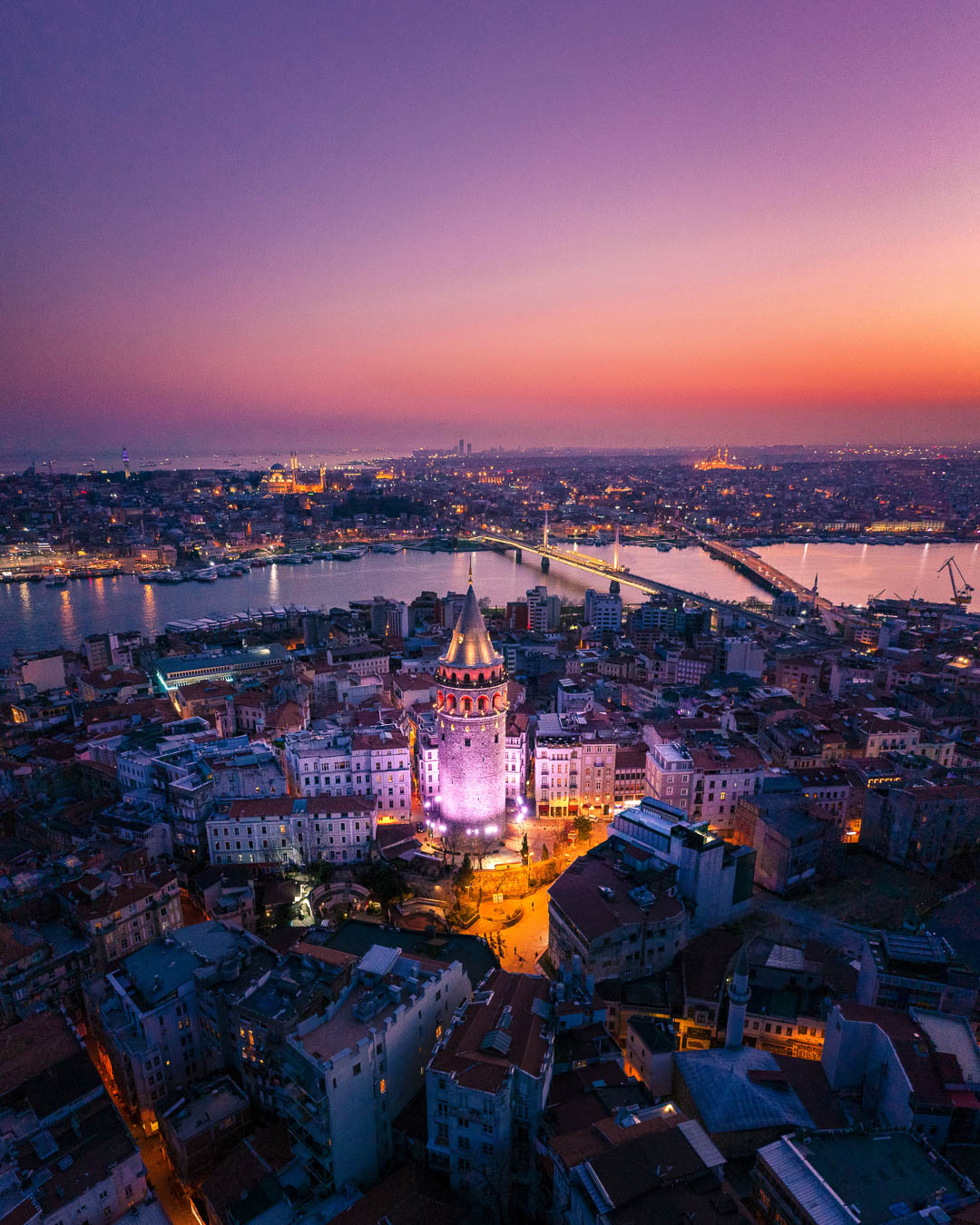
Start in Istanbul. It's the only city in the world that sits on two continents, and within a twenty-minute walk you can stand inside the largest cathedral of late antiquity, walk through an Ottoman sultan's bedroom, and lose yourself in a covered market that's been open since 1461.
Galata Tower and the old city at dusk.
Here's what makes Istanbul different from every other city. You're not visiting one Istanbul; you're visiting four. There's the Byzantine one, where Hagia Sophia still feels improbable when you stand under its dome and try to figure out how sixth-century engineers held it up. There's the Ottoman one, where Topkapı Palace stretches across a promontory and you walk through three centuries of imperial decisions. There's the bazaar Istanbul, where the Grand Bazaar has been doing its thing since 1461 and the Spice Bazaar still smells the way you hope it will. And then there's the everyday one, on the Asian side at Kadıköy, where actual Istanbullular eat fish at the Sunday market and complain about the rent. Take the ferry across the Bosphorus at sunset at least once. It costs less than a euro and it's the view you'll remember most. Three days is the minimum. Four if you want to do it without burning out.
§
02
02Landscape · Nevşehir Province
Cappadocia.
1 min read
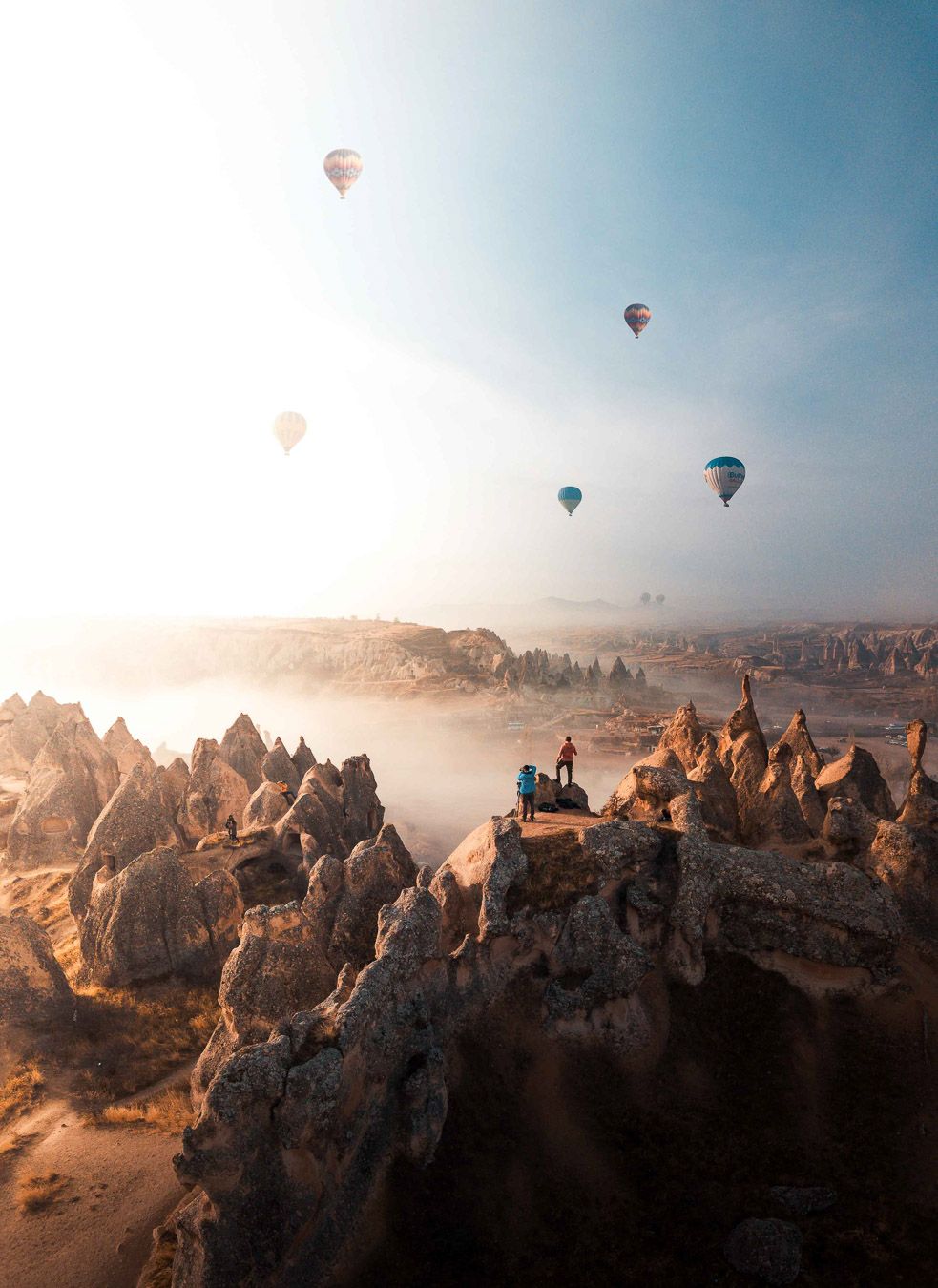
Cappadocia is the closest you'll come to walking on another planet without leaving Earth. Ten million years of volcanic eruptions and erosion left behind a landscape of pale rock towers, hidden valleys, and entire cities carved straight down into the ground.
Yes, you've seen the balloon photo a thousand times. Go anyway. The balloon flight itself, drifting silently at sunrise while a hundred other balloons share the same air, lasts about an hour and you'll be quiet for most of it. On the ground, the Göreme Open-Air Museum holds a cluster of rock-cut Byzantine churches with frescoes from the 10th to 12th centuries, still vivid because the volcanic tuff stays dry. Then there's Derinkuyu, an underground city that burrows deep beneath the surface and could shelter twenty thousand people. Walking through it makes you genuinely curious about what they were hiding from. Stay in a cave hotel in Göreme or up the hill in quieter Uçhisar. Fly into Kayseri or Nevşehir. UNESCO inscribed the region in 1985.
Balloons over Cappadocia at first light.
§
03
03Coast & Antiquity · Muğla and Antalya
The Muğla and Antalya Coast.
1 min read
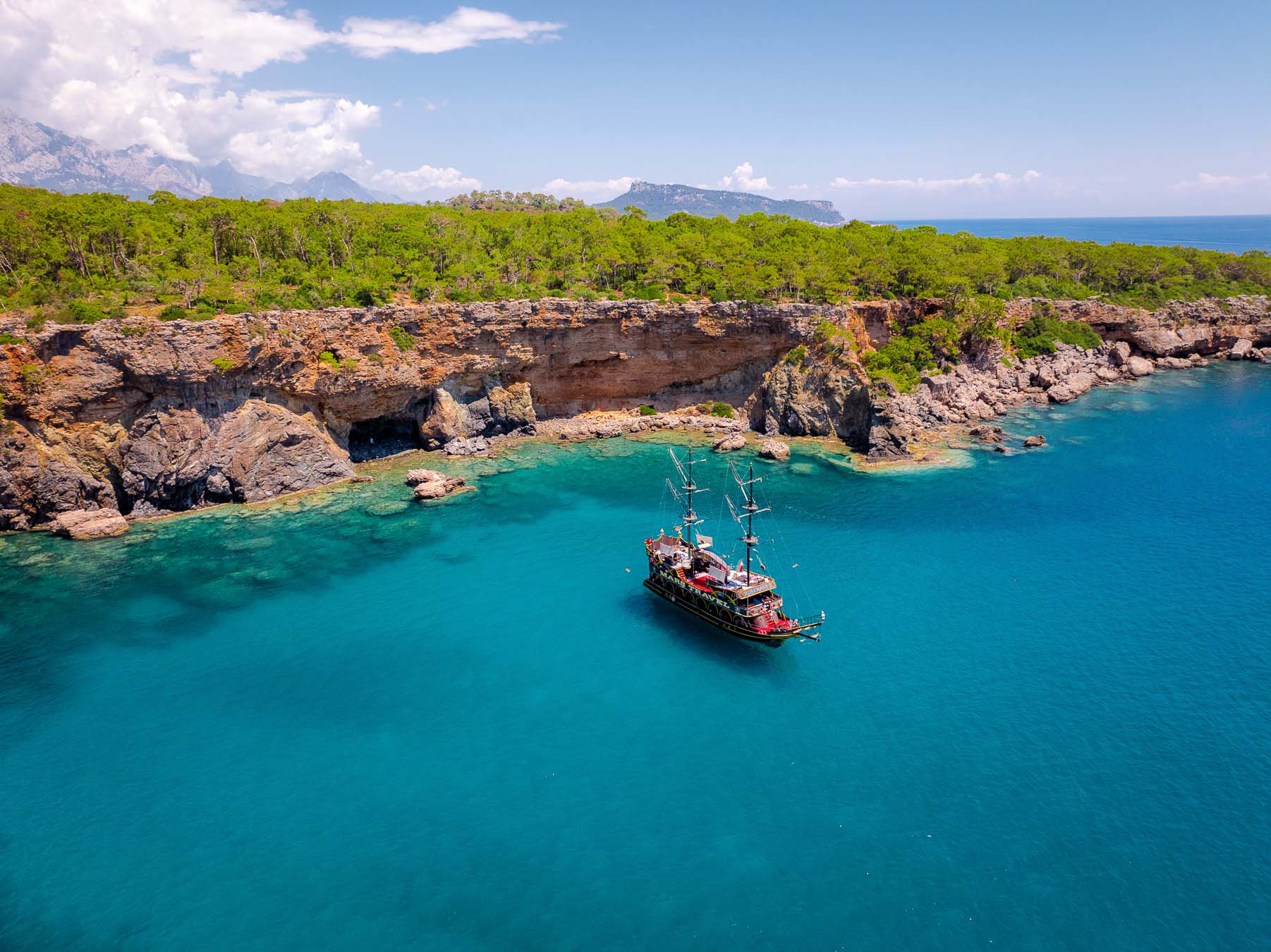
If you've ever wanted to swim inside an actual Roman harbour without anyone charging you to do it, the Muğla and Antalya coast is where you do that. This is the Türkiye most people fall in love with.
A bay at Phaselis, the Roman harbour city near Kemer.
The Lycian Way walking trail follows this coastline for over 500 kilometres past more than twenty ancient cities. Patara has an entire Roman city behind one of the longest sandy beaches in the country. Olympos sits in a river valley where Roman ruins and pine forest just blur into each other. Phaselis has three ancient harbours you can swim between. Most of these sites are unfenced and free. Ölüdeniz, near Fethiye, has the lagoon that's been on every Turkish tourism poster for forty years (yes, it's that blue). Kaş and Kalkan still feel like the fishing towns they were before the resorts arrived, with cobbled streets and tiny harbours full of wooden boats. About those boats: between May and October, traditional wooden yachts called gulets run multi-day routes from Göcek and Fethiye, visiting beaches no road reaches. Book one. It's the best way to see this coast.
§
04
04Roman Ruins · İzmir Province
Ephesus.
1 min read
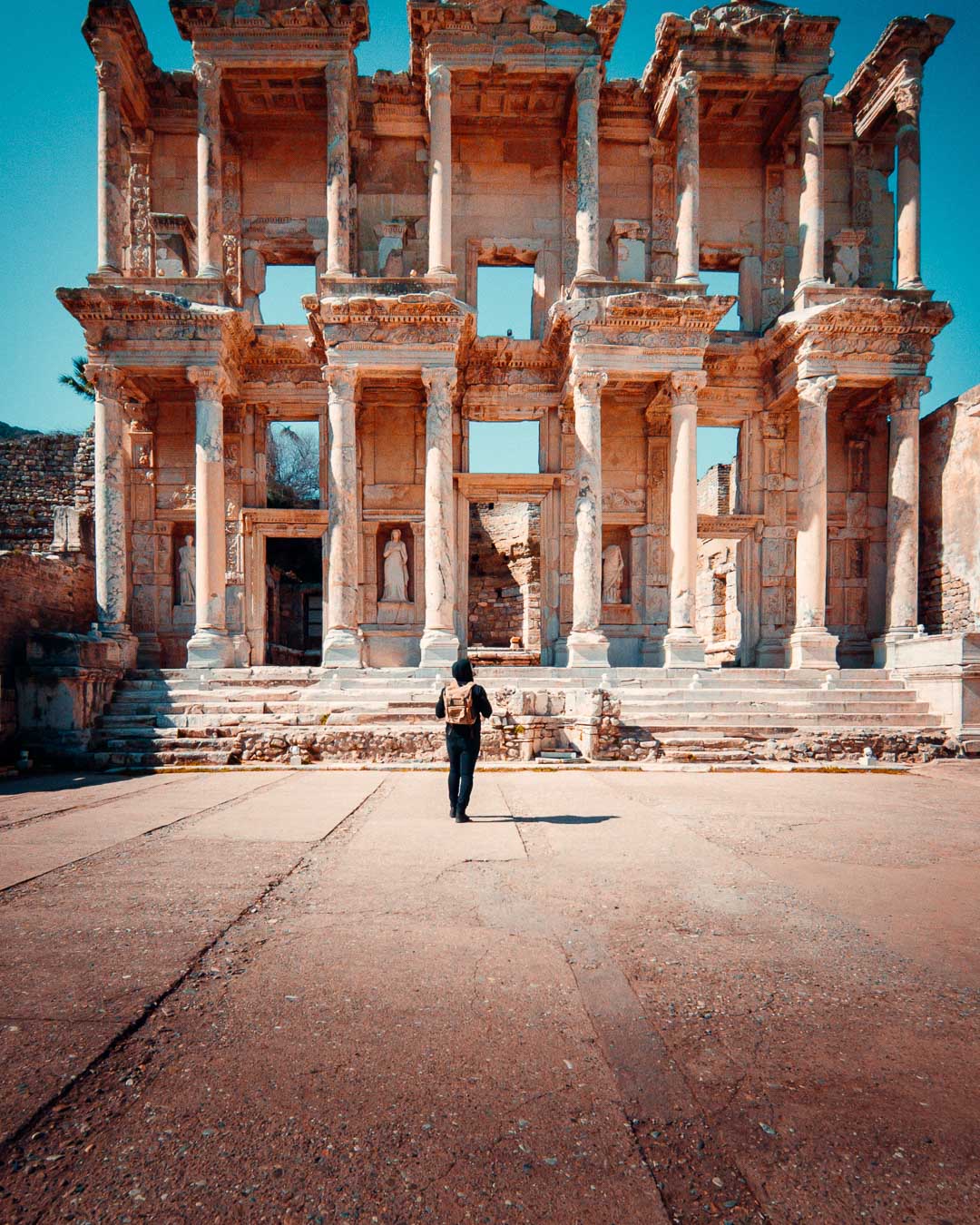
Ephesus is the closest you'll come to actually walking through a Roman city. Four kilometres of marble streets, intact mosaics, a theatre that still seats 25,000 people, and the most beautiful library facade left from the ancient world.
The Library of Celsus at Ephesus.
Here's the move: enter at the upper gate, the Magnesia Gate, and walk downhill. You'll pass the Odeon, the agoras, the Temple of Hadrian, then turn a corner and the Library of Celsus just appears in front of you. It was finished around 117 AD as a tomb for the city's Roman governor, and the two-storey facade you're looking at was put back together by Austrian archaeologists in the 1970s using the original stones that had fallen where they fell. The Terrace Houses need a separate ticket and are worth it. They preserve mosaics and frescoes on the actual walls of Roman family homes. End at the Great Theatre, where Paul of Tarsus delivered the sermon recorded in Acts. UNESCO inscribed Ephesus in 2015, which feels late for what's there. Base in Selçuk village, fly into İzmir, and start early. By mid-morning the cruise ships arrive.
§
05
05Natural Wonder · Denizli Province
Pamukkale and Hierapolis.
1 min read
Pamukkale looks fake the first time you see it. White terraces of mineralised water cascading down a 200-metre cliff, with the ruins of a Greco-Roman spa city sitting on top of them. It's been doing this for several thousand years.
The terraces are calcium carbonate, deposited by hot mineral water emerging from the hillside at body temperature (about 35°C). You walk barefoot on a designated stretch. Most of the terraces are off-limits to protect them, and rightly so. Above them sits Hierapolis, founded by Eumenes II of Pergamon in the second century BC as a thermal spa. Romans, Byzantines, and finally earthquakes did their work, and what's left is a Roman theatre, one of the largest preserved necropoleis in Anatolia, and Cleopatra's Pool, where you can swim among submerged column fragments for a separate fee. UNESCO inscribed the combined site in 1988. Two practical things: go early morning or late afternoon (midday is brutal and the tour buses pack in between 11am and 2pm), and bring something soft for your feet, because the travertine is harder than it looks.
§
06
06Archaeology · Şanlıurfa Province
Şanlıurfa and Göbekli Tepe.
1 min read
Şanlıurfa is where you go to see something older than civilisation itself. Göbekli Tepe, twenty minutes from the city centre, is a temple complex built around 9,500 BC, six thousand years before Stonehenge. It rewrote what we thought we knew about prehistoric humans.
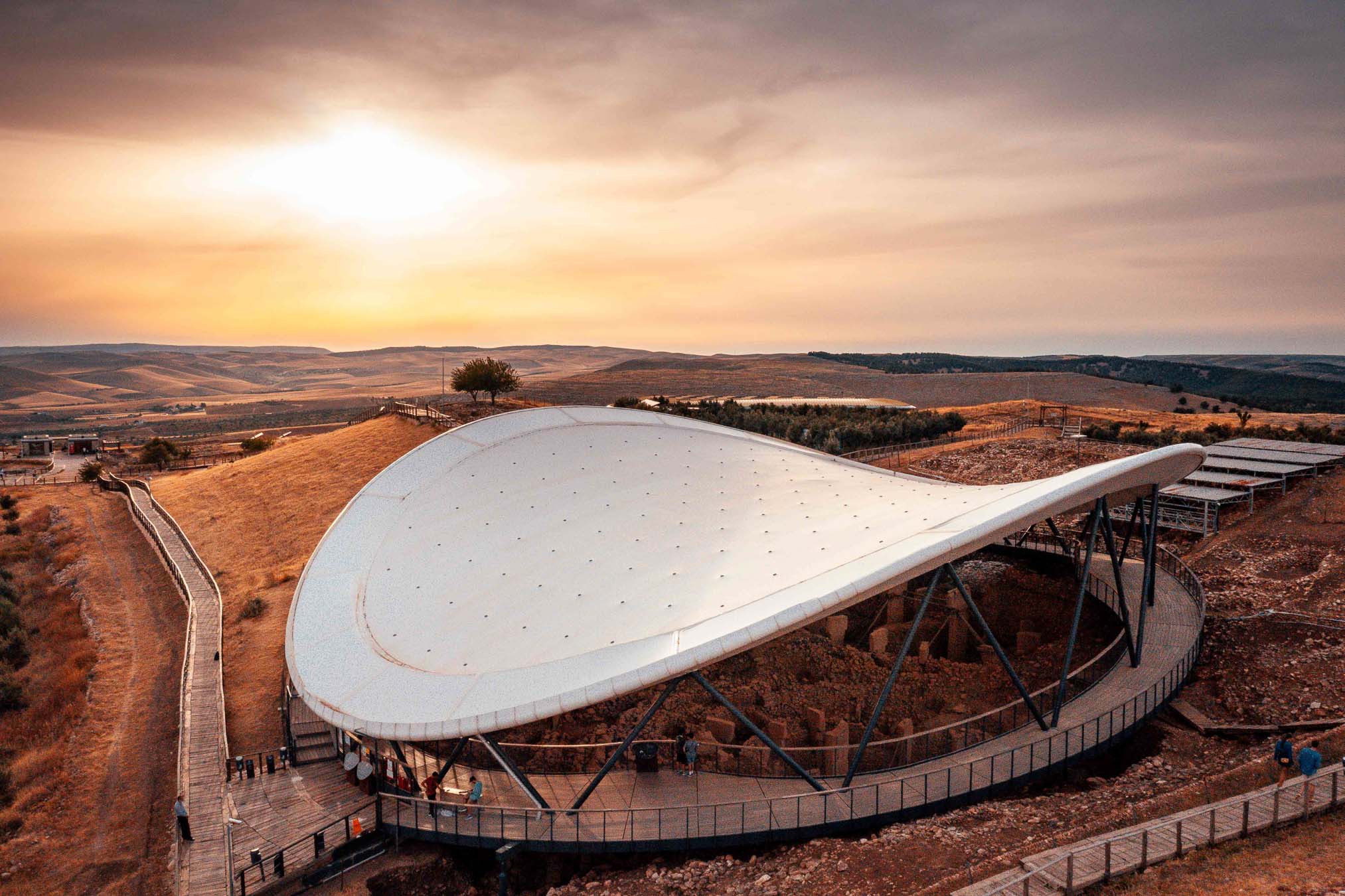
The shelter over the main enclosures at Göbekli Tepe.
The thing about Göbekli Tepe is that it shouldn't exist. The textbooks said hunter-gatherers couldn't organise monumental architecture; you needed agriculture and settled societies first. Then someone started digging on a hill outside Urfa and pulled up T-shaped pillars covered in animal carvings, arranged in circles, dated to 9,500 BC. UNESCO inscribed it in 2018. Only about ten percent has been excavated, so most of it is still under the hill, which is a strange thing to think about while you're standing there. The city of Şanlıurfa itself earns the trip on its own. Balıklıgöl, the pool of sacred fish in the old town, is a pilgrimage site claimed by all three Abrahamic faiths. The kahvaltı here, particularly the çiğ köfte made by men who've done nothing else for thirty years, is one of the best breakfasts in the country. And the local Urfa peppers will change how you think about heat.
§
07
07Stone Town · Mardin Province
Mardin.
1 min read
Mardin doesn't look like the rest of Türkiye. It's a sand-coloured stone town clinging to a limestone ridge above the Mesopotamian plain, and the view from the top stretches for a hundred kilometres into Syria.
People have lived here for over four thousand years, which means almost every street you walk on has been walked on before by Romans, Byzantines, Arabs, Turks, Kurds, and Armenians. The old town packs in Syriac Orthodox churches, Artuqid-era madrasas with stone carving so intricate it stops making sense up close, and the fourth-century Deyrulzafaran Monastery, which is still active as the seat of the Syriac Orthodox Patriarch. Aramaic, the language Jesus spoke, is still spoken in the villages around the city. The view from the citadel is the one that explains everything. You can see exactly why people kept fighting over this hill for forty centuries. Pair Mardin with a half-day in Midyat for silver craftwork, or push east to Hasankeyf if you can stomach the partially flooded ruin.
§
08
08Mountains · Trabzon and Rize
Trabzon and Rize.
1 min read
If you only know Türkiye from the coasts, the Black Sea highlands will reset everything. This is the rainiest, greenest corner of the country, with mountains rising to nearly four thousand metres and a food culture that exists nowhere else.
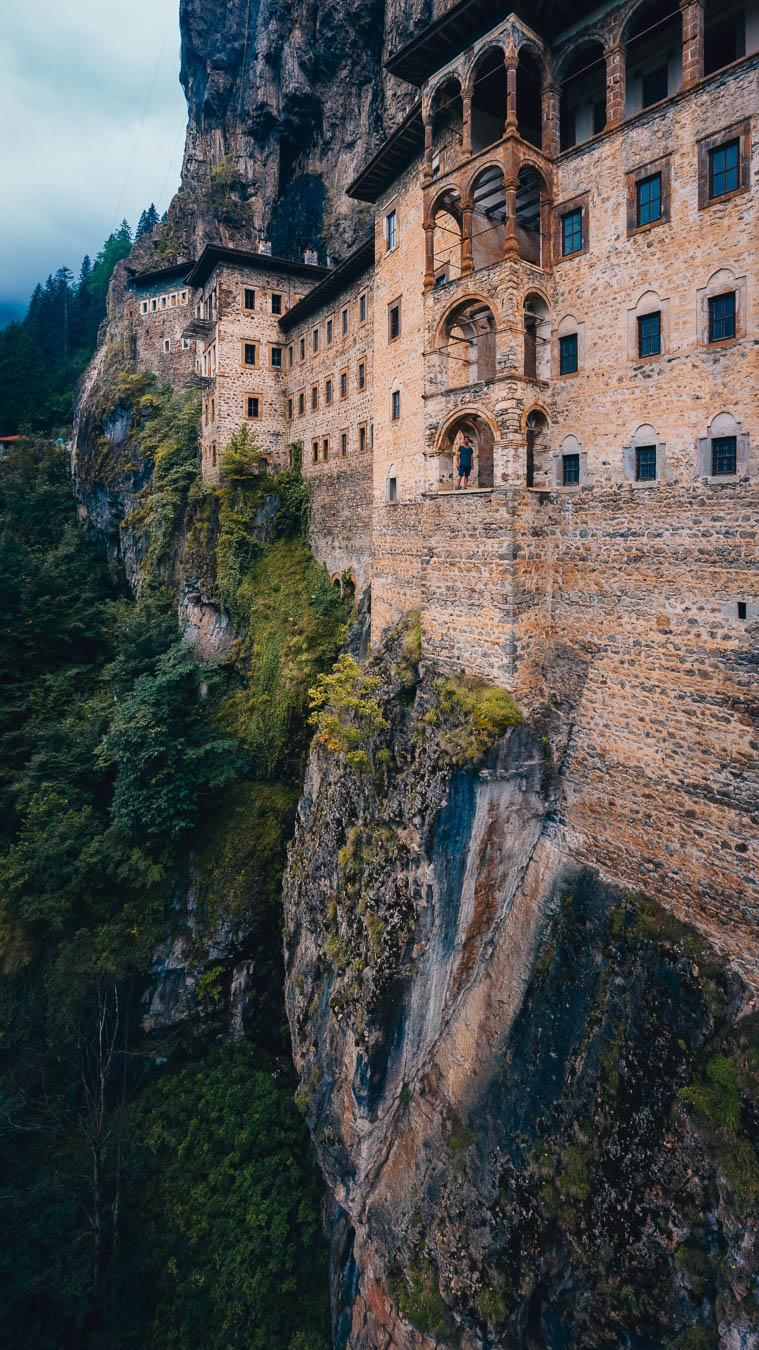
Start with Sümela Monastery. It was founded in the fourth century on a vertical cliff face in the Altındere valley, and it's been clinging to that rock for sixteen hundred years regardless of who controlled the territory below. Go early. By ten in the morning the tour buses arrive, and the magic is in seeing the building emerge from valley mist before the crowds. Uzungöl, a lake in a tea-and-spruce valley, gets the most photographs; for the version without the crowds, walk the hillside paths above the village. Behind it all rises the Kaçkar Mountains National Park, with peaks to 3,937 metres and highland villages where time runs slower. The food carries this region: Akçaabat köfte made without egg or breadcrumb and grilled over wood, hamsi anchovy in season from October to February (fried, baked into rice, folded into bread, a dozen other things), and muhlama, a corn-and-cheese fondue that you'll eat at any village highland breakfast above a thousand metres. The region peaks in May and June, when the green becomes almost cartoonish.
Sümela Monastery in the Altındere valley.
§
09
09Archaeology · Adıyaman Province
Adıyaman and Mount Nemrut.
1 min read
In the first century BC, a king you've never heard of decided he wanted to be remembered as a god. So he built a tomb sanctuary on top of a 2,134-metre mountain in southeastern Türkiye, surrounded himself with giant stone statues of Greek and Persian deities, and waited. Most of him is still up there.
The king was Antiochus I of Commagene, ruler of a small Hellenistic kingdom that flourished briefly after Alexander's empire broke apart. His official religion was a deliberate fusion of Greek and Persian gods, practical for ruling between two cultures. So the statues he built at the summit depict him sitting alongside hybrid deities like Zeus-Oromasdes and Apollo-Mithras-Helios-Hermes. They originally stood eight to ten metres high. Earthquakes did what earthquakes do; the heads were knocked from the bodies centuries ago and now sit at their feet, staring straight back at you. UNESCO inscribed the site in 1987. Go at sunrise from the east terrace or sunset from the west. The light at those hours is what makes the photographs work. Base in Kahta below the summit or in Adıyaman city. The road closes for snow in winter, so plan May to October.
§
10
10Food · Gaziantep Province
Gaziantep.
1 min read
If you're serious about food, Gaziantep is the city you build a trip around. UNESCO inscribed it as a Creative City of Gastronomy in 2015, and it's not a marketing line. The food here genuinely runs deeper than anywhere else in the country. Once you have done these ten, our hidden gems guide picks the eight places for the second trip.
Start with baklava. Antep makes about thirty variations using the local pistachios, and even one bite makes every baklava you've eaten before feel like a draft. Then there's lahmacun with the Antep spice ratio (which you will not find done correctly anywhere else), beyran, the breakfast soup of rice and lamb in a dark broth that most places stop serving before noon (a few legendary spots open at 3:30am, finish by lunch, and have been doing it for forty years). Also slow-cooked lamb dishes like kuzu tandır and simit kebabı made in kitchens that have been at it for generations. Beyond the food, the Zeugma Mosaic Museum holds one of the largest mosaic collections in the world, rescued from the Zeugma archaeological site before the Birecik Dam flooded it in 2000. The Gypsy Girl mosaic alone is worth the trip. Combine Gaziantep with Şanlıurfa, ninety minutes east by car, for the strongest possible southeast Türkiye base.
Watch the films
See Türkiye in motion.
4 films from across our journeys in Türkiye.
Written by
Show Me Türkiye Editorial
Field notes, routes, and city guides from across Türkiye.
Reviewed by Halil Bekar, founder of Show Me Türkiye
We use essential and analytics cookies to keep this site running and understand how it is used. Analytics runs with IP anonymisation. With your consent, we may also use marketing cookies in the future. Read more in our Cookies Policy.
Cookie preferences
Choose which cookies you allow. Essential and analytics cookies are always on (legitimate interest, IP anonymisation). Your choice is saved on your device and you can change it anytime from the Cookies Policy page.
Essential
Required for core features such as remembering your language and that you have seen this notice. Always active.
Analytics
Google Analytics with IP anonymisation, used to understand how the site is used in aggregate. Always active under legitimate interest.
Marketing
Reserved for future use (e.g. retargeting). Off until you allow it.