Planning Guide · Transport

Getting Around Türkiye

Buses, fast trains, domestic flights, ferries and the open road

Show Me Türkiye September 2026 10 min read
Field notes

Getting around: what we tell friends.

  1. 01 Check which Istanbul airport. Istanbul Airport (IST) is on the European side, Sabiha Gökçen (SAW) on the Asian side. A cheap connecting flight from the wrong one can cost you half a day.
  2. 02 Under six hours, stay on the ground. Once you add airport time, the bus or the fast train usually wins, and you arrive in the middle of town.
  3. 03 Book fast trains early. Istanbul, Ankara and Konya trains fill up on Fridays, Sundays and public holidays. Buses rarely sell out outside the bayram holidays.
  4. 04 Ask about the servis. Many bus companies run a free minibus between the otogar and the town centre. Ask at the ticket counter before you pay for a taxi.
  5. 05 Keep small cash for the dolmuş. Shared minibuses are the backbone of coastal and village travel, and not every driver takes cards.
  6. 06 Rent the car after Istanbul, not in it. The coast and the Black Sea highlands are made for driving. Central Istanbul is not.

Türkiye is a big country, and how you move between places shapes the trip more than most people expect. Plan the transport well and a two-week route feels unhurried. Plan it badly and your best days disappear into airport queues and bus stations.

The good news is that the options are genuinely good. Domestic flights are frequent and fairly priced, the intercity bus network reaches every town, and a growing high-speed rail line links Istanbul with the Anatolian interior.

This guide explains how each one works, when to use it, and the mistakes we see travellers make most often. For visas, money and SIM cards, see the First Guide.

§
01Quick answer

The quick answer.

Three rules that cover most trips.

2 min read

Fly the long hauls. Istanbul to Cappadocia, Antalya, Trabzon or the southeast is a day on the road or about an hour and a half in the air. Unless the journey itself is the point, fly.

Bus or train anything under six hours. Once you count the trip to the airport, security and the transfer at the other end, the ground option is often just as fast and drops you in town.

Rent a car for the coast and the mountains. The Lycian coast, the Aegean villages and the Black Sea highlands are full of places buses do not stop. A car turns them from a logistics problem into the best part of the trip.

Common journeys and how we would do them
JourneyBest optionTime
Istanbul → AnkaraHigh-speed trainabout 4.5 h
Istanbul → CappadociaFlight to Nevşehir or Kayseriabout 1.5 h, then 45 min to Göreme
Istanbul → AntalyaFlightabout 1 h 10
Istanbul → TrabzonFlightabout 1 h 30
Istanbul → GaziantepFlightunder 2 h
Antalya → FethiyeCoastal bus or carabout 3 h
Fethiye → PamukkaleBusabout 3 h
Pamukkale → İzmirBusabout 4 h
Gaziantep → Şanlıurfa → MardinRental carabout 600 km as a loop

Times are typical and exclude transfers unless stated. Traffic, season and holiday weekends all stretch them.

§
02Domestic flights

Domestic flights in Türkiye.

The fastest way across a very wide country.

1 min read

Four carriers cover most routes: Turkish Airlines, its lower-cost sister AJet, Pegasus and SunExpress. Almost every route runs through Istanbul or Ankara, so direct flights between two smaller cities are the exception rather than the rule.

Book two or three weeks out and fares are usually reasonable. Last-minute tickets on busy routes can cost several times more. Low-cost fares often exclude checked luggage, so compare the total, not the headline price.

Choose the right airport. The name of your destination is not always the name of the airport. The ones travellers get wrong most:

§
03Intercity buses

Intercity buses and the otogar.

The network that reaches everywhere.

2 min read

Every town in Türkiye has an otogar, a bus station where dozens of private companies sell tickets from their own counters. Large operators such as Kâmil Koç, Pamukkale Turizm and Metro Turizm cover the whole country, and regional companies fill the gaps. You can compare times and prices on obilet.com or buy at the counter.

The coaches are better than most visitors expect: reclining seats, seatback screens, and an attendant who comes round with tea, coffee and a small snack. On long routes the bus stops every few hours at a roadside rest area for food and a stretch.

Seat etiquette is real. When you book, you will be asked your gender. Companies avoid seating a woman travelling alone next to a man she does not know, so booking a seat for two people together is the easiest way to sit side by side.

Otogars are often outside town. Newer bus stations sit on the ring road, not in the centre. Many companies run a free servis minibus between the otogar and their office in town. Ask when you buy your ticket.

Night buses save a hotel night on long routes such as Istanbul to Cappadocia, but you arrive tired and early. We use them for one leg of a trip, not every leg.

For a journey of four or five hours, the bus is not the budget option. It is often simply the better one.

§
04Fast trains

High-speed trains (YHT).

City centre to city centre, across the Anatolian plateau.

1 min read

The YHT (Yüksek Hızlı Tren) is Türkiye's high-speed rail service, run by TCDD Taşımacılık. The corridors travellers use most connect Istanbul, Eskişehir and Ankara, Ankara and Konya, and Istanbul and Konya. A newer line runs east from Ankara to Sivas.

Istanbul to Ankara takes about four and a half hours, which is competitive with flying once you count airport time. Book on the official site, ebilet.tcddtasimacilik.gov.tr, where fares are set by the operator.

Check the Istanbul station on your ticket. The city has several YHT stops, and they are far apart. Pick the one closest to where you are staying.

There is no high-speed line to Cappadocia, the Mediterranean coast or the Black Sea. For those, fly or take the bus. The slow and scenic Doğu Ekspresi (Eastern Express) from Ankara to Kars is a journey in its own right, and its seats sell out months ahead in winter.

§
05Airport to town

From the airport into town.

The first hour of the trip, sorted.

2 min read

Istanbul Airport (IST). The M11 metro line runs from the airport towards Gayrettepe, where it connects with the M2 line into the centre, and towards Halkalı. Havaist airport buses run on eleven routes into the city, including Taksim, and İETT city buses add a few more.

Sabiha Gökçen (SAW). The M4 metro line runs from the airport to Kadıköy on the Asian side. From Kadıköy, a ferry across the Bosphorus is the best possible introduction to the city.

Antalya (AYT). The AntRay T1A tram leaves from both terminals. It takes about 50 minutes to İsmetpaşa, the stop for Kaleiçi. Havaş airport buses run roughly hourly to the western edge of the city, and city bus 800 serves the Lara and Konyaaltı beach areas.

Dalaman (DLM). Havaş shuttles run to the Fethiye bus station via Göcek, and to the Marmaris bus station. Muttaş also runs shuttles to both town centres.

Nevşehir and Kayseri (Cappadocia). Public options are limited. Most visitors pre-book a shared or private shuttle to their hotel in Göreme, about 45 minutes away.

Arriving late at night, with children or with a lot of luggage, a pre-booked transfer is usually worth the extra cost. You walk out, find your name and go.

§
06Driving

Renting a car in Türkiye.

Where it makes sense, and where it does not.

1 min read

Outside the big cities, driving in Türkiye is straightforward. Main roads are in good condition and road signs are in Turkish with English on the major routes. Traffic drives on the right.

To rent, you will need a driving licence valid in your home country, a credit card for the deposit, and usually to be at least 21. An International Driving Permit is recommended, even though rental desks do not always ask for it.

Tolls are electronic. Motorways and the big bridges use the HGS system, a sticker on the windscreen. Rental cars come with one, and the company charges your tolls afterwards. Ask how they bill before you drive away.

Where a car pays off: the Lycian coast between Fethiye and Antalya, the Aegean villages around Bodrum and Datça, the southeast loop through Gaziantep, Şanlıurfa and Mardin, and Cappadocia's valleys. In the Black Sea highlands, some roads up to the yaylas are steep and unpaved, and a small city car is the wrong choice.

Where it does not: central Istanbul. Parking is close to impossible and the traffic is among the worst anywhere. Pick the car up on your way out of the city, or at your next airport.

§
07Dolmuş · Taxis

Dolmuş, taxis and city transport.

How to get around once you have arrived.

1 min read

The dolmuş is a shared minibus that runs a fixed route, usually with the destinations on a sign in the windscreen. You can flag one down anywhere along the route, pay the driver, and ask to get off wherever you like. In Fethiye, for example, dolmuş minibuses shuttle between town and Ölüdeniz throughout the day.

In Istanbul, one card, the Istanbulkart, works on the metro, tram, buses, Marmaray and the public ferries. Antalya has its own city card for the tram and buses. Buy either from the machines at stations.

Taxis should always run the meter (taksimetre). In Istanbul, the BiTaksi and Uber apps both book licensed yellow taxis, which gives you a fare estimate before you get in and removes the meter argument entirely.

§
08Ferries

Ferries.

Some of the best journeys in the country are on water.

1 min read

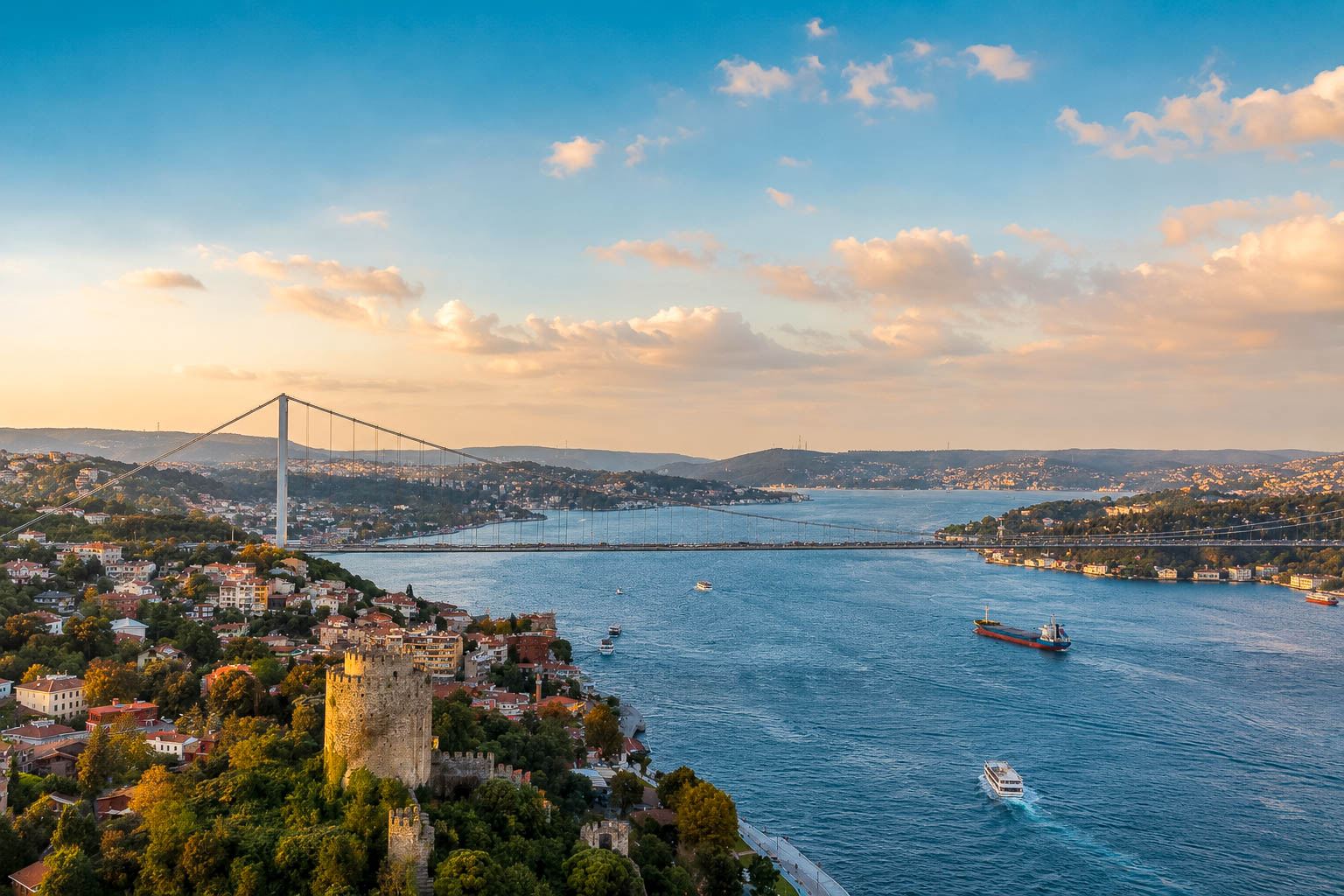
Across the Bosphorus. Istanbul's public ferries (vapur) connect the European and Asian sides for the same Istanbulkart fare as a bus. The Eminönü and Karaköy crossings to Kadıköy are among the best ways to see the city, especially near sunset.

Across the Sea of Marmara. Fast ferries link Istanbul with the Bursa side of the Marmara, about an hour and a half door to door. It is an easy way to add a Bursa weekend to a week in Istanbul.

Fast ferry crossing the Sea of Marmara between Istanbul and Bursa
The fast ferry across the Sea of Marmara, the easy way to add Bursa to an Istanbul stay.

Across the Dardanelles. Car ferries cross the strait at Çanakkale, the gateway to Troy and Gallipoli.

To the Greek islands. In season, ferries run from Bodrum to Kos, from Marmaris to Rhodes, and from Kaş to Meis (Kastellorizo). Schedules change with the season, so check close to your date.

§
09FAQ

Questions we get asked.

Short answers to the most common ones.

2 min read
What is the best way to travel around Türkiye?

Fly between regions, take the bus or high-speed train for journeys under about six hours, and rent a car for the coast and the mountains. Most good itineraries mix all three.

Is there a train from Istanbul to Cappadocia?

There is no high-speed line to Cappadocia. The quickest option is a flight to Nevşehir or Kayseri, about an hour and a half, followed by a 45-minute transfer to Göreme. Overnight buses are the budget alternative.

Do I need to book buses in advance?

Usually not. Departures on popular routes are frequent. The exception is the bayram public holidays, when half the country travels at once and seats sell out days ahead.

Can you use Uber in Türkiye?

In Istanbul, Uber works as a taxi-hailing app that books licensed yellow taxis. BiTaksi does the same. Elsewhere, use taxi ranks or ask your hotel to call one.

Do I need an International Driving Permit?

It is recommended. Rental companies generally accept a licence valid in your home country, but carrying an International Driving Permit avoids problems if you are stopped.

How do I get from Istanbul Airport to the city centre?

Take the M11 metro and change to the M2 at Gayrettepe, or ride a Havaist airport bus, which runs on eleven routes including Taksim. A taxi or pre-booked transfer is simplest with heavy luggage.

Show Me Türkiye
Written by
Show Me Türkiye Editorial
Field notes, routes, and city guides from across Türkiye. Last checked September 2026.
Ready to plan?

Put it into a route.

Our curated routes do the transport planning for you, day by day, with every connection already worked out.

See the routes →